
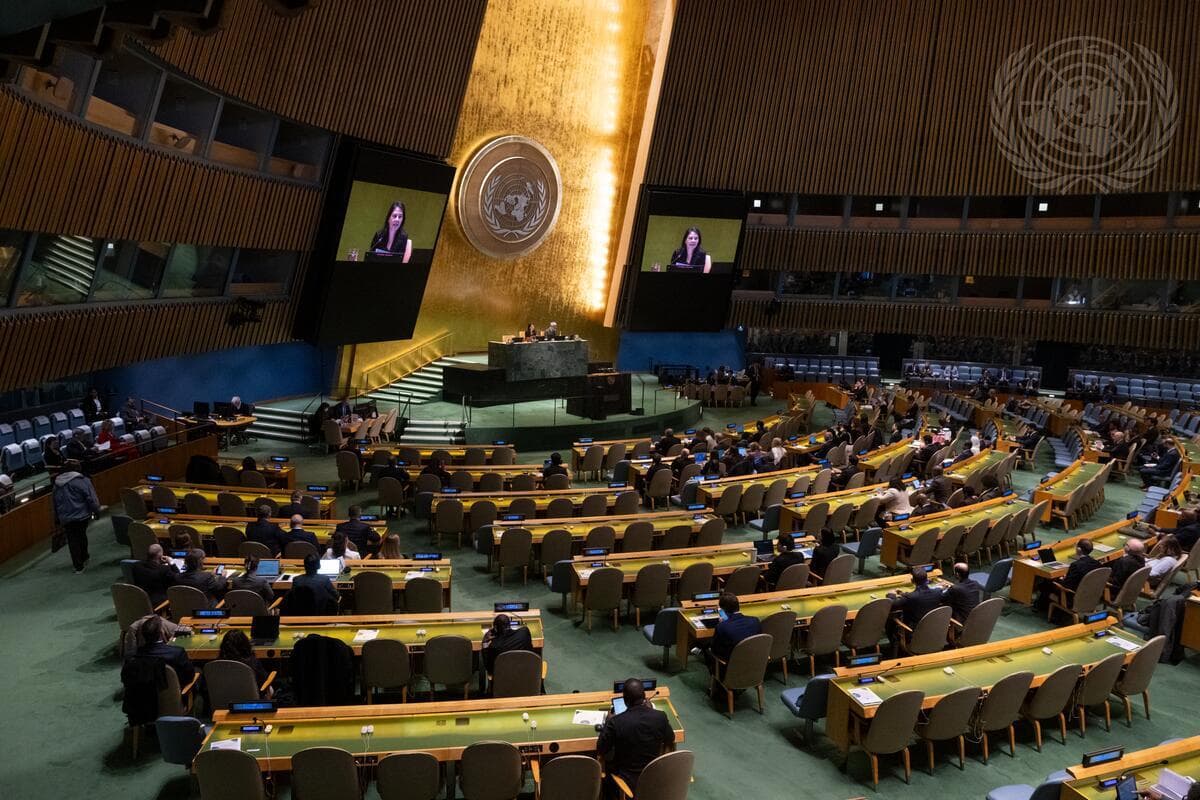
The world just voted for mental health. The GCC said yes
Every GCC country has voted in favour of the UN General Assembly’s new Political Declaration on noncommunicable diseases (NCDs) and mental health.
The UAE, Saudi Arabia, Qatar, Kuwait, Bahrain and Oman were among 175 nations which all backed the declaration which made a public commitment, in front of the world, to treat mental health as part of the same hard policy agenda as diabetes, cancer, heart disease and chronic lung conditions. Only the United States and Argentina voted against.
In a world that struggles to agree on anything, that margin matters. Not because a UN declaration magically changes what happens in clinics on Monday morning, or in HR offices on Tuesday afternoon. It does not. But because this is how the global narrative shifts.
The numbers behind the declaration
NCDs are the world’s leading killers. WHO estimates they killed at least 43 million people in 2021, around 75% of non-pandemic-related deaths globally, with 18 million people dying before age 70.
Mental health is not a niche alongside that crisis. In 2019, 970 million people were living with a mental disorder, and mental disorders account for 1 in 6 years lived with disability. People with severe mental health conditions die 10 to 20 years earlier than the general population.
WHO puts it plainly: NCDs claim around 18 million premature deaths each year, while mental health conditions affect over a billion people globally.
So when governments vote for a declaration that treats NCDs and mental health together, they are acknowledging something many employers and health leaders have felt for years: the body and the mind are already in the same system, whether policy admits it or not.
Why this declaration feels different
The political declaration is not just another well-meaning text. It comes with headline targets that are designed to be quoted back at governments.
WHO describes three “fast-track” outcome targets to be achieved by 2030:
- 150 million fewer tobacco users
- 150 million more people with hypertension under control
- 150 million more people with access to mental health care
It also includes process targets that are deliberately measurable, including expectations around national plans, primary care capacity, financial protection and monitoring systems.
That is the shift. Mental health is being pulled out of the “awareness” lane and put into the “delivery” lane, with numbers attached.
The part employers should not ignore: digital harms are now on the record
One of the most striking elements is what the declaration and WHO’s framing choose to name explicitly: digital harms.
WHO’s own summary of the declaration highlights “social media exposure, excessive screen time, harmful content, and the risks of mis- and disinformation.”
And in the political declaration text itself, governments commit to addressing risks to mental health and well-being linked to digital technology, including reducing children’s screen use, tackling harmful content, and strengthening digital literacy.
This matters in the GCC for a simple reason: the region is young, highly connected, and heavily exposed to always-on digital life at home, at school and at work. When a UN declaration names screen time and harmful content, it gives ministers, regulators, educators and employers a legitimate policy hook to act, without being dismissed as “soft” or “moral panic”.
What the GCC “yes” vote means in real terms
A UN political declaration is not a law. It will not, by itself, fund a therapist network, rewrite an insurance benefit, or train primary care staff.
But it does three very practical things.
1) It creates a shared scoreboard
Once targets are adopted and repeated, the conversation changes. Health leaders start asking: what is our baseline, what is our plan, what is our funding line, what are we reporting publicly?
For GCC governments that have already signaled ambition on health, well-being, productivity and quality of life, this declaration strengthens the expectation that mental health outcomes are part of national performance, not a side initiative.
2) It strengthens the case for integration, not siloed services
The declaration’s core idea is “equity and integration”. WHO’s framing emphasizes an “integrated approach”, linking prevention and care for NCDs with mental health.
Practically, that points towards:
- mental health support embedded in primary care pathways, not only specialist settings
- chronic disease programmes that screen for depression and anxiety, because adherence, lifestyle change and outcomes depend on it
- workforce planning that treats mental health capability as a health system requirement, not an optional add-on
3) It legitimises stronger regulation, including on commercial and digital determinants
WHO highlights a sharper regulatory focus on issues like e-cigarettes, unhealthy food marketing to children, front-of-pack labelling and trans fats.
In the declaration text, there is explicit language on protecting children from the harmful impact of marketing of unhealthy foods, including in digital environments.
For the GCC, that is not abstract. It points to the next phase of health policy: not just clinics and campaigns, but environments that shape behaviour, from advertising standards to school food to platform accountability.
What this means for employers, starting now
If you lead an organisation in the GCC, you do not need to wait for a new regulation to act. The direction of travel is already clearer than most business leaders realise.
Here is what “alignment” looks like in practice over the next 12 to 24 months:
- Treat mental health as core business risk and capability. Not a wellness week. Track it like any other performance driver, because productivity losses “significantly outstrip” direct care costs, and the disability burden is well established.
- Build benefits and access, not just awareness. The global target is access to care at scale. If your plan stops at webinars, you are behind the narrative.
- Integrate mental health into chronic disease support. Your workforce already lives with NCD risk factors. NCDs are still the dominant drivers of premature mortality globally.
- Create a digital well-being stance that is specific. The declaration now names screen time and harmful content. Employers should be asking what “always-on” means inside their culture, and what guardrails exist for younger employees.
- Train managers for real conversations. If stigma, poor-quality care, and under-resourced services remain global realities, workplaces become the early warning system.
The punchline is not that employers must become mental health providers. It is that employers have to stop pretending they are not already part of the system.
The bottom line
The UN vote is not the finish line. It is the moment the world agreed, overwhelmingly, that mental health belongs in the same category as the biggest killers and cost-drivers on the planet, and that progress should be measured, funded, and regulated accordingly.
The GCC’s unanimous “yes” should be read as a regional signal: mental health is moving from aspiration to expectation.
For healthcare leaders, it means integration and delivery. For employers, it means stepping up before you are forced to, because the narrative has already turned.