UAE resilience in a time of pressure
In a special edition of Connect For Health, we take a closer look at Cigna Healthcare’s new Well-being & Health Pulse in the UAE, a timely survey exploring how residents are navigating regional uncertainty, rising costs, family responsibilities, workplace pressure and changing expectations around wellbeing.
Hosted by Scott Armstrong, this episode brings together Leah Cotterill, Hana Agil and Suzanne Gandy for a practical conversation about what the findings mean for leaders and workplaces right now.
The headline is encouraging: people in the UAE continue to report strong levels of safety, optimism, belonging and family support. But the discussion also makes clear that resilience should not be mistaken for an absence of pressure.
The episode explores the role of employers in supporting people as whole individuals, not just employees. That means recognising financial strain, job security concerns, caregiving responsibilities, mental health, family life and the need for clear, human leadership during uncertain times.
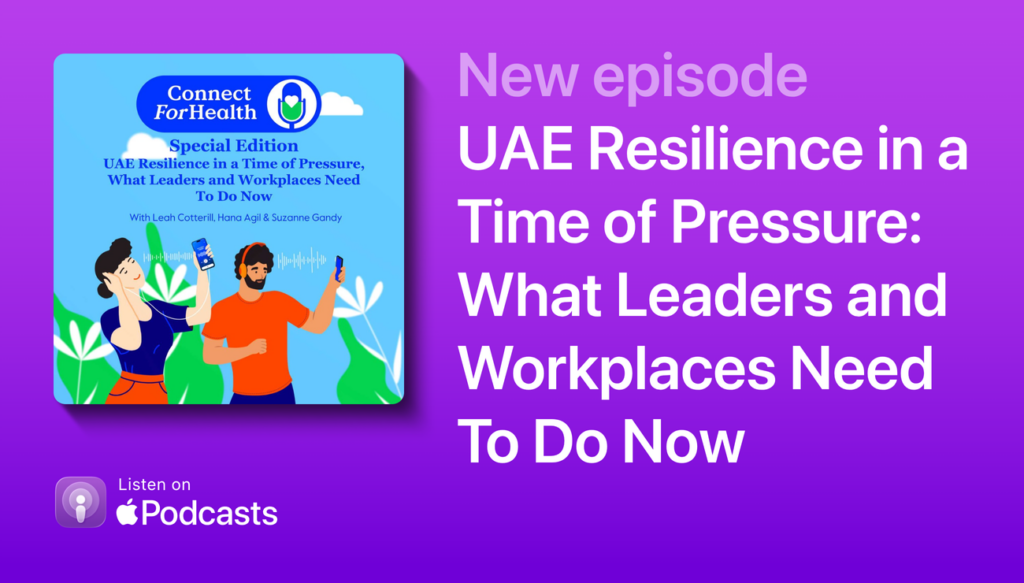
Read the white paper: Well-being & Health Pulse in the UAE
As the conversation makes clear, resilient workplaces are not built in a crisis. They are built through trust, clarity, communication, manager support and cultures where people feel safe enough to say when they are under pressure.
The full Well-being & Health Pulse in the UAE: Resilience in a Time of Pressure white paper provides a deeper look at the data behind the discussion.
Conducted in April 2026 among 380 respondents across the UAE, the survey measured overall wellbeing and six connected pillars: physical, mental, financial, social, family and workplace wellbeing. The report captures resident sentiment during a period shaped by regional conflict, cost pressures and evolving work-life expectations.
Some of the findings are striking:
89% of respondents say they feel physically safe in the UAE, 83% feel emotionally safe and 86% say they feel at home. 70% report their overall wellbeing as excellent or very good, while 80% rate family wellbeing positively, making it the strongest wellbeing pillar in the study.
But the pressure points are just as important. Financial wellbeing is the weakest pillar, with only 53% rating it positively. Just 45% say they feel able to manage cost pressures with rising costs, while 49% feel positive about their ability to manage expenses and income.
The workplace picture is mixed. Among working respondents, 69% rate workplace wellbeing positively, yet only 56% feel positive about job security. The report also finds that employees are looking for more than traditional benefits, with mental health support, financial planning assistance, therapy access and gym memberships remaining underprovided despite strong demand.
For leaders, the message is clear: wellbeing is not one-dimensional. Physical health, mental health, financial confidence, family support, social connection and workplace culture are all linked.
The white paper sets out five recommendations for employers and wellbeing partners: build wellbeing around the whole person, treat financial wellbeing as a health issue, make family-supportive work a wellbeing priority, expand access to mental health and therapy support, and strengthen recovery, sleep and prevention.