
Why physical and psychological safety belong together at work
A worker may have the right equipment, understand the risks and know the task ahead. But what happens if they arrive exhausted, distressed or unsure they can work safely? Can they say so, and what happens next?

Physical and psychological safety meet in that moment. Two winners from the mentl awards 2025, Dulsco People in Travel and ADNOC Group in Energy, show how organisations can make the route from concern to support part of everyday operations.
Their stories in the Moving the Needle playbook focus on practical choices: make it safe to raise a concern early, respond clearly and put support within reach of the people doing the work.
Dulsco People: make mental readiness part of safety
Dulsco People treated mental health as equal to physical safety. In the case study, pre-shift self-health declarations gave employees a recognised way to raise concerns about their readiness before work began.
That is a meaningful question in frontline work, where fatigue, stress and emotional load may affect someone’s ability to carry out a task safely. Asking about readiness creates an opportunity to respond before pressure becomes risk.
The response mattered as much as the question. The model included no-penalty rest, a 24/7 Medical Supervisor Team, paid mental health days and welfare engagement. Employees had a route towards rest or referral, and leaders had a clearer pathway to follow.
Speaking up needs a reliable response
The playbook frames the connection through two questions: can the person work safely, and can they say when they cannot? A worker needs confidence that an honest answer will lead to support.
Dulsco’s reported evidence included more than 5,300 employees engaged in Welfare Month, 1,320 sessions delivered and 15,175 participants reached. The case study also reported a 17.3 per cent reduction in significant Accident Frequency Rate.
These figures describe the evidence presented in the case study. They do not, by themselves, establish that a single wellbeing measure caused the safety result. What the operating model shows is how an organisation can connect disclosure to a practical response.
Safe to work. Safe to speak. Both matter.
ADNOC Group: bring support to the worksite
ADNOC Group’s Energy for Wellbeing programme addressed the challenge of reaching people across operational, remote and high-pressure environments. Support needed to be visible and accessible beyond a head-office setting.
The programme connected several routes: Wellness Desks at sites, mental health sessions and roadshows, remote access through an Employee Assistance Programme and teleconsultations, in-house psychiatry and psychology, and psychological support after unusual workplace incidents.
Each part served a purpose. Visible contact points helped people find a starting place. Remote routes extended access. Clinical services provided a path to specialist care, while post-incident support addressed situations requiring a follow-up response.
Connect benefits to the situation someone is facing
The ADNOC case study also describes mapping support against real employee situations. For childcare, that included leave, flexi time, nursing support, parent meetings and remote work. Elder-care support brought together options such as leave, medical coordination, insurance and EAP access.
For relocation, the routes included support with housing, transport, visas and shifts alongside health and assistance services. The practical question was which support fitted the employee’s circumstances and how they could reach it.
Reported programme reach included 25,000 employees, more than 250 mental health sessions and roadshows, and more than 100 online mental health courses. EAP and teleconsultation access were available around the clock.
Four lessons for other workplaces
Include mental readiness in safety conversations. Make space to discuss fatigue, stress and emotional load alongside the other factors affecting readiness for work.
Make early disclosure safe. Be clear about what happens when someone says they are struggling. A route to support needs a response people can trust.
Put help where work happens. Use existing briefings, site visits, visible access points and remote routes to make support easier to find across different locations and working patterns.
Prepare the response before it is needed. Define who responds after an incident, how support is offered, how confidentiality is protected and how follow-up will happen.
A safer shift begins before the work starts
The shared lesson is practical: people need to be safe to do their work and able to say when something is wrong. That requires clear routes, prepared people and support that continues beyond the first conversation.
Read more in the Moving the Needle playbook. If your organisation is making a difference, explore the mentl awards 2026 and visit mentlawards.com for current entry details.
Programme details and figures are drawn from the mentl awards Moving the Needle playbook, Dulsco People (page 11) and ADNOC Group (page 16), as presented in the physical and psychological safety guide. They reflect the evidence reported in those cases.
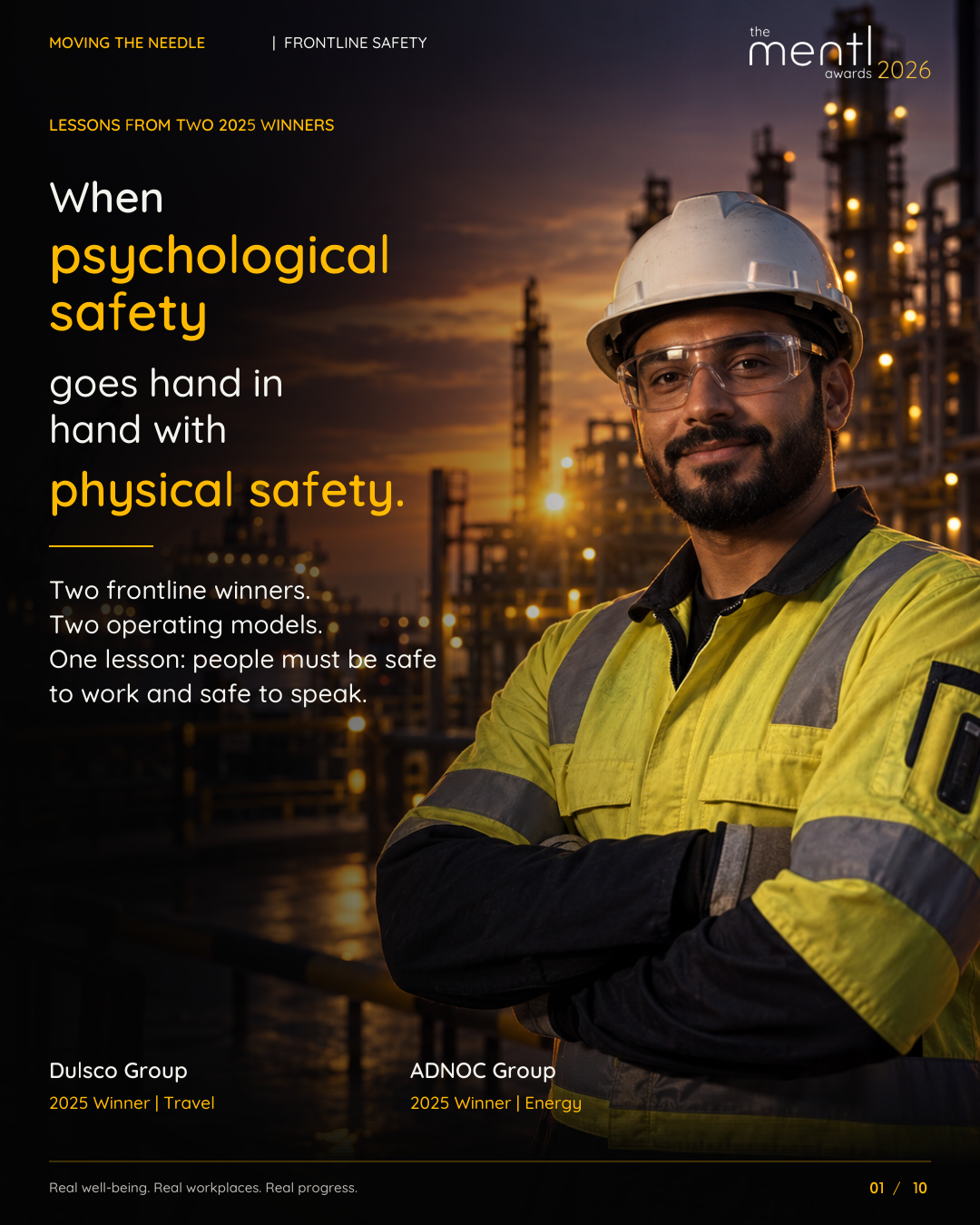
Safe to work. Safe to speak.
Explore the illustrated frontline safety guide, with practical lessons from Dulsco and ADNOC Group. Download the PDF to share the ideas with your team.
Give your entry a fresh perspective
Meet the mentl Entry Feedback Studio — now in beta. Get gentle, practical feedback informed by hundreds of past entries and judges’ comments, helping you see what comes through clearly and where more context or supporting evidence could strengthen your submission.
AI-assisted and reviewed by mentl. Your work and words remain yours. The studio is optional and available to all entrants; feedback is separate from independent judging and does not predict an award outcome. Meet the mentl awards 2026 judging panel.
Try the Entry Feedback Studio →
Your work. Your story. Your impact.
Is your organisation making a difference to mental health and wellbeing? Share the work, the people behind it and the change you can show.
More support for your 2026 entry: 5 reasons to enter and 5 ways we help · How the free Entry Studio works · Start or finish your entry.