

What judges look for: 10 ways to strengthen your mentl awards entry
You know the work mattered. Someone found support sooner. A team felt able to speak. A community gained something it had been missing. The challenge in a mentl awards entry is helping a judge understand that difference as clearly as you do.

The mentl awards 2026 entrant guide brings together 10 practical lessons drawn from judges’ feedback across 2023–2025. They follow a simple thread: explain the need, show what you did and give the evidence of what changed for people. Meet the mentl awards 2026 judging panel.
Use these pointers alongside your category’s current criteria and entry requirements. They are a way to make your story clearer, rather than a substitute for answering the questions in your chosen category.
1. Find your category and make your case
Start by reading the criteria and eligibility rules. Make the entrant, location and period covered clear in your opening paragraph. Then match each criterion to an achievement and a piece of proof.
If your claim is that people could access support more easily, show the waiting-time data, with dates, and feedback from people using the service. Keep the strongest evidence in the main entry. Where a criterion is less relevant, explain why.
2. Start with the need
What was happening, who was affected and why did it need to change? A dated survey finding, a gap in provision or a repeated concern gives the judge a starting point.
Connect the activity to a specific mental health or wellbeing need. A busy calendar alone cannot explain the problem you were trying to solve.
3. Show how you listened
Explain whose views you gathered, how and when. Include the number of participants where you have it, then identify the insight that changed a decision.
For example, if feedback revealed a language barrier, explain how you adapted the material or delivery and checked whether access improved. Be open about whose views were missing and how you responded.
4. Make the plan clear
Give readers a clear route from the need to the objective, the activity and the intended outcome. Name the people responsible, the partners involved and the resources available. A short timeline can make the sequence easier to follow.
For an individual nomination, distinguish the nominee’s decisions and actions from the wider team’s contribution. Judges need to understand what that person brought to the work.
5. Bring your difference to life
Describe what people could access before the initiative and what became possible afterwards. Show how the approach fitted the audience’s language, culture, accessibility needs or working patterns.
A specific example of use is stronger than calling an idea innovative. Explain which barrier you addressed and what evidence suggests the change helped.
Bring the heart. Show the evidence.
6. Show the work in action
Tell the story of delivery: what launched, when, where and for whom. Include actual participation or uptake where available. Describe a challenge, the adjustment you made and what you learnt.
Keep completed work, pilots and future plans distinct. A dated example helps establish what was operating during the entry period.
7. Make the change measurable
Attendance tells a judge how far an activity reached. Outcomes explain what changed in access, wellbeing, confidence or behaviour. For your strongest result, include the starting point, later result, timeframe, sample size and measurement method.
Be honest about limitations. If there is no baseline, use the best evidence available and explain what it can demonstrate. A carefully qualified result is more useful than a broad claim the evidence cannot support.
8. Bring the human story
Choose a short story that illustrates an outcome you have already described. Set out the person’s starting situation, the support they received and the change they experienced. Pair their feedback with a result or follow-up where possible.
Use permission-cleared or anonymised details. Make clear whether the example reflects wider feedback or one person’s experience. The person’s experience should remain at the centre.
9. Explain how the good work lasts
What continues when the initial activity ends? It might be a policy, a support pathway, a trained team or a routine that people now rely on. Explain who owns the next phase and how it is resourced.
Separate confirmed arrangements from proposed expansion. Show how you review progress, act on feedback and improve the work over time.
10. Make every page count
Give each answer a clear claim, a specific example and supporting evidence. Label attachments, refer to them precisely and explain the important result in the main entry.
Finally, ask a colleague unfamiliar with the work to read it. Can they explain the need, your contribution and the outcome? Check dates, figures, entry limits and every supporting link.
Bring the heart. Show the evidence.
The strongest story is one a new reader can follow: a real need, a thoughtful response, delivery you can explain, evidence of change and a contribution that lasts. Your work matters. Help judges see why.
Explore the mentl awards 2026 and visit mentlawards.com for current categories and entry requirements. For examples of work recognised in previous years, explore the Moving the Needle playbook.
Based on the mentl awards 2026 entrant guide, What judges look for, drawing on judges’ feedback across 2023–2025.
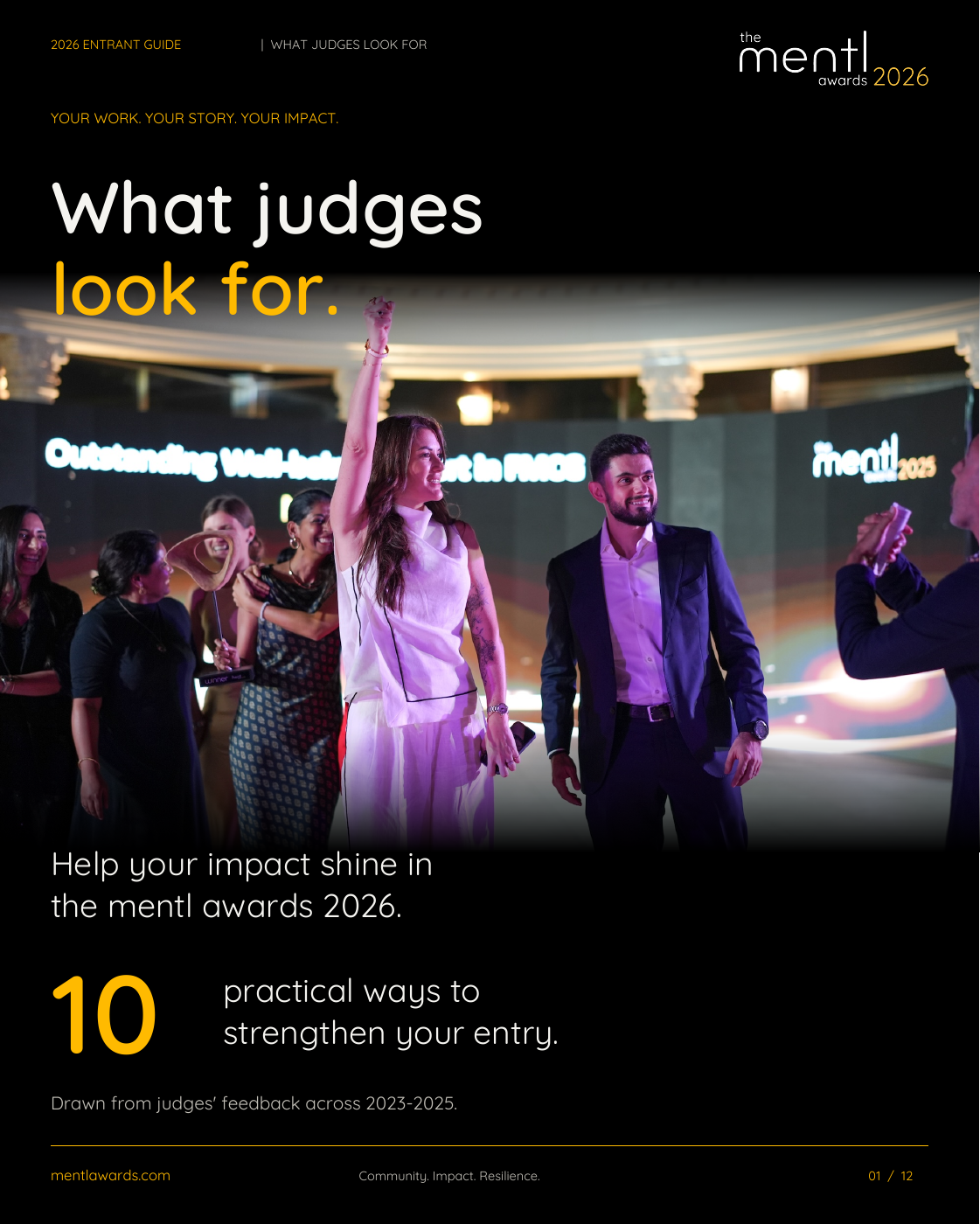
What judges look for
Keep the 10-point entrant guide beside you as you build your submission. Click the cover or download the full PDF.
Give your entry a fresh perspective
Meet the mentl Entry Feedback Studio — now in beta. Get gentle, practical feedback informed by hundreds of past entries and judges’ comments, helping you see what comes through clearly and where more context or supporting evidence could strengthen your submission.
AI-assisted and reviewed by mentl. Your work and words remain yours. The studio is optional and available to all entrants; feedback is separate from independent judging and does not predict an award outcome.
Try the Entry Feedback Studio →

Your work. Your story. Your impact.
Is your organisation making a difference to mental health and wellbeing? Share the work, the people behind it and the change you can show.
More support for your 2026 entry: 5 reasons to enter and 5 ways we help · How the free Entry Studio works · Start or finish your entry.