Workplace wellbeing under pressure: what good employers do differently
A wellbeing policy is easy to celebrate when business is going well. The harder test comes when employees are anxious, workloads are rising and managers are expected to hold everything together. Do people still feel safe to speak? Can they take time off without taking their laptop? And does support survive when budgets tighten?

In this episode of the mentl space, Scott Armstrong speaks with Paul Firth, Founder and Managing Director of Lyra Wellbeing MENA, about workplace wellbeing under pressure. Recorded as part of the mentl awards Moving the Needle series, the conversation connects burnout, trust and everyday leadership with the work that stood out to Paul as an awards judge.
Watch the conversation
Listen to the podcast
Build trust before you need it
Reflecting on the first half of 2026, Paul describes how regional uncertainty added to pressures employees were already carrying. Work continued, but so did concerns about family, security and what might happen next. Employers had to consider both business continuity and the people delivering it.
Scott questions why internal communication so often becomes a priority only when a crisis arrives. Paul agrees that organisations which had already invested in their culture were better placed to respond. He also describes enquiries about support that slowed when the immediate situation appeared to ease—a reminder of how easily wellbeing can become a short-term reaction.
The lesson for leaders is to make listening and clear communication part of ordinary working life. Trust is built through repeated experience: being heard, understanding decisions and seeing that commitments lead to action.
Give employee voice somewhere to go
Psychological safety is practical. Paul describes an environment in which people can question an approach or suggest an idea without expecting humiliation. That matters for innovation as well as for raising concerns.
At Lyra, he gives a simple example: a team member is nominated each month to run the weekly team meeting. Paul contributes to the agenda, but does not own it. Clinical operations, account management and learning and development colleagues can all bring ideas about how the business works.
The point is not to remove leadership responsibility. It is to give people a meaningful role in shaping how objectives are achieved. Different roles and different people may need different levels of structure and autonomy.
Support the managers carrying pressure from both sides
Paul calls middle management a bottleneck: business demands arrive from above, while the needs of the team come from below. Asking managers to show empathy adds little if they are given no training, time or support to do it.
“They’re not there to be proxy psychologists.”
Paul Firth, Lyra Wellbeing MENA
He talks about noticing consistent changes from someone’s usual behaviour: a normally reliable colleague missing deadlines, for example, or making uncharacteristic errors. The invitation is to open a supportive conversation about what has changed, rather than make assumptions about its cause.
Managers also need to model the boundaries they encourage. A message about switching off carries less weight when the person delivering it works around the clock and expects the team to do the same.
Make annual leave mean time away
One of Paul’s clearest examples is also one of the simplest. When a colleague offers to take a laptop on holiday just in case, his answer is no. Leave is time to recharge.
Scott and Paul discuss how technology has removed the physical boundary that once separated leaving the office from being available to work. Protecting recovery now requires deliberate choices about contact, expectations and handovers.
That thinking also applies to AI and productivity. Paul asks employers to examine how work is delivered, rather than simply filling every hour saved with more tasks. Faster tools do not resolve workload pressure if the demands keep expanding.
An EAP needs a culture that lets people use it
Paul describes widely different engagement with employee assistance programmes across Lyra’s clients, despite the underlying service being fundamentally the same. In his experience, company culture is a major part of that difference.
The stronger examples make wellbeing part of business decisions as they happen. Support is visible in everyday behaviour, rather than confined to an occasional campaign. His comparison is with health and safety: something embedded in the way an organisation operates.
What an awards judge wants to understand
Reflecting on the mentl awards, Paul recalls entries in which the organisation’s belief in its work came through clearly. Employee contributions helped make that story convincing. The most useful examples did not necessarily depend on a large budget. Meet the mentl awards 2026 judging panel.
A practical change to leave, a trusted wellbeing champion or a better way to listen can all matter. The entry needs to explain the value created and provide evidence of the outcome. Paul also encourages entrants to be open about approaches that did not work and what they learned from them.
For organisations preparing an entry, that suggests a useful starting point: capture the need, the action, the employee experience and the change you can demonstrate. Tell the story as it develops.
Turn your impact into an entry
Lyra Wellbeing MENA is supporting the mentl awards as a bronze sponsor for the second year running. If your organisation is improving mental health and wellbeing, use the guides below to find the right category and make your evidence clear.
Your quick entry toolkit
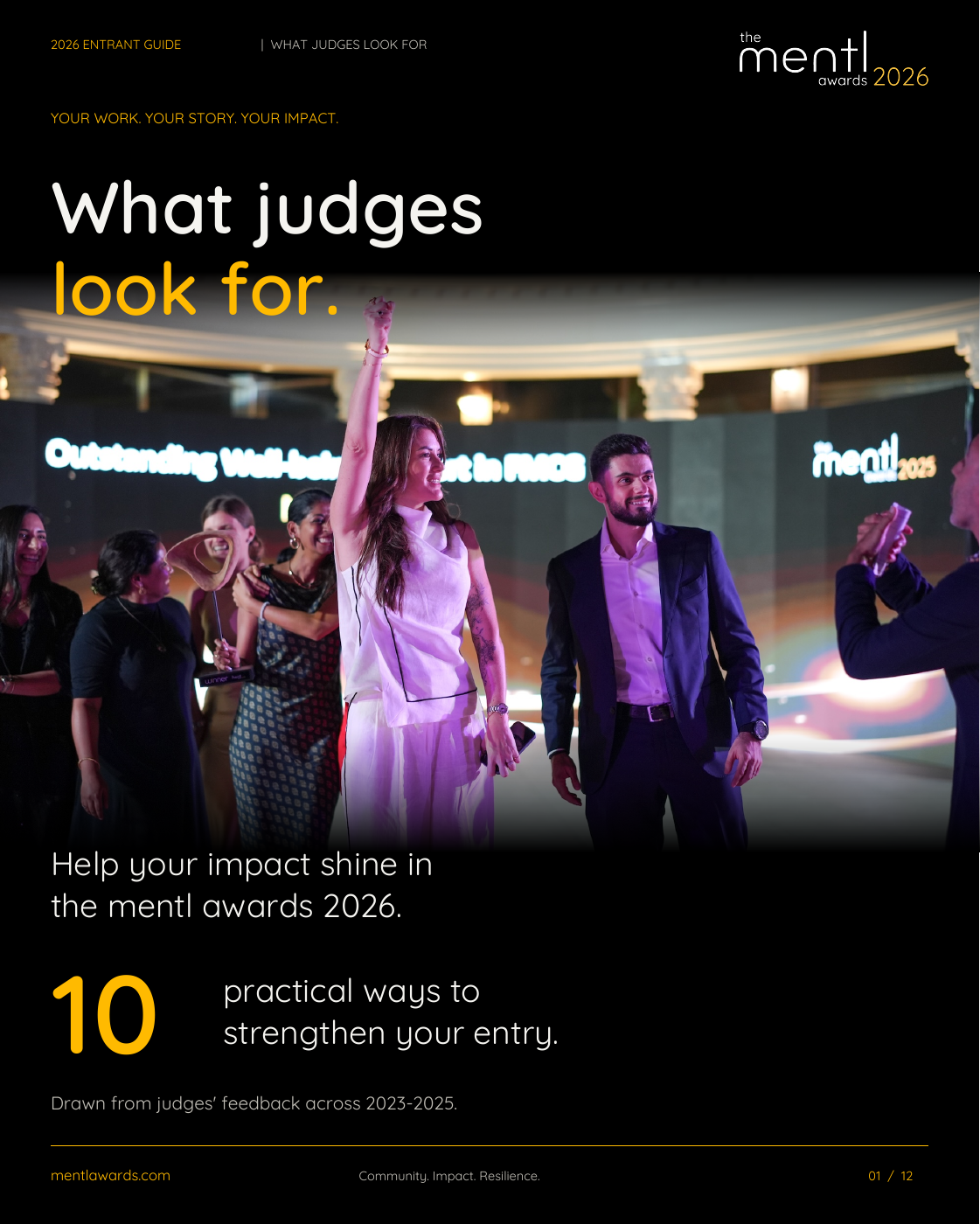
Download: What judges look for →
Ten ways to help your impact shine, from explaining the need to showing what changed.
Download: Quick look at the categories →
Find your starting point, then explore the category guidance and requirements.
Give your entry a fresh perspective
Meet the mentl Entry Feedback Studio — now in beta. Get gentle, practical feedback informed by hundreds of past entries and judges’ comments, helping you see what comes through clearly and where more context or supporting evidence could strengthen your submission.
AI-assisted and reviewed by mentl. Your work and words remain yours. The studio is optional and available to all entrants; feedback is separate from independent judging and does not predict an award outcome.
Try the Entry Feedback Studio →
More support for your 2026 entry: 5 reasons to enter and 5 ways we help · How the free Entry Studio works · Start or finish your entry.